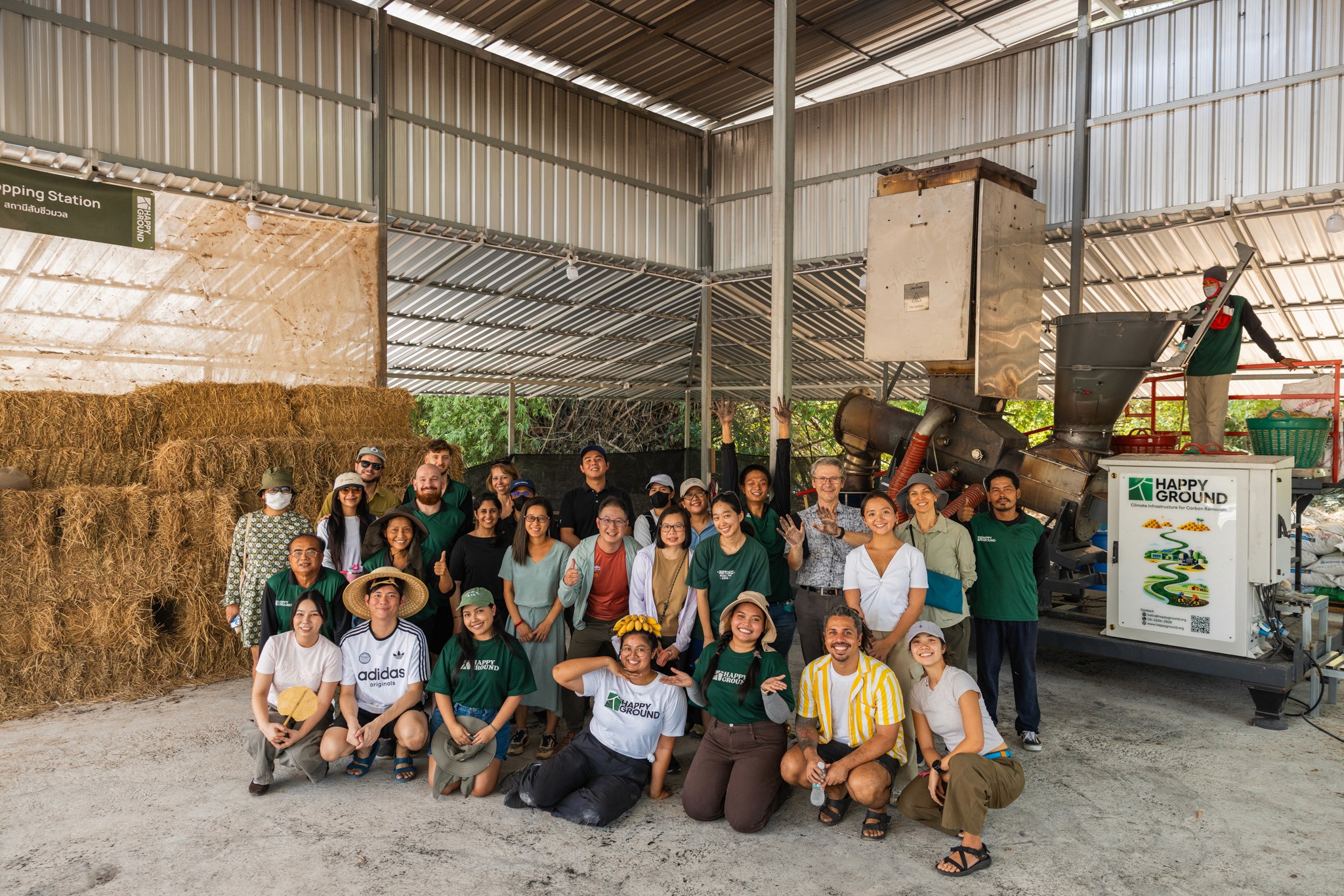
Climate Transition for Enterprise Supplychain
How Happy Ground is working with KTIS, a 10,000-farmer sugarcane supply chain, to turn agricultural activity into measurable, investable climate action.
Enterprise
Aug 11, 2025

Overview
A sugar mill doesn't just process sugarcane.
It sits at the center of an entire agricultural ecosystem: 10,000 farmers managing approximately 800,000 rai, or around 128,000 hectares of land, alongside agricultural residues, factories, logistics, field teams, researchers and infrastructure.
Our collaboration with Kaset Thai International Sugar (KTIS) started with a much simpler question than carbon credits:
What actually works for farmers?
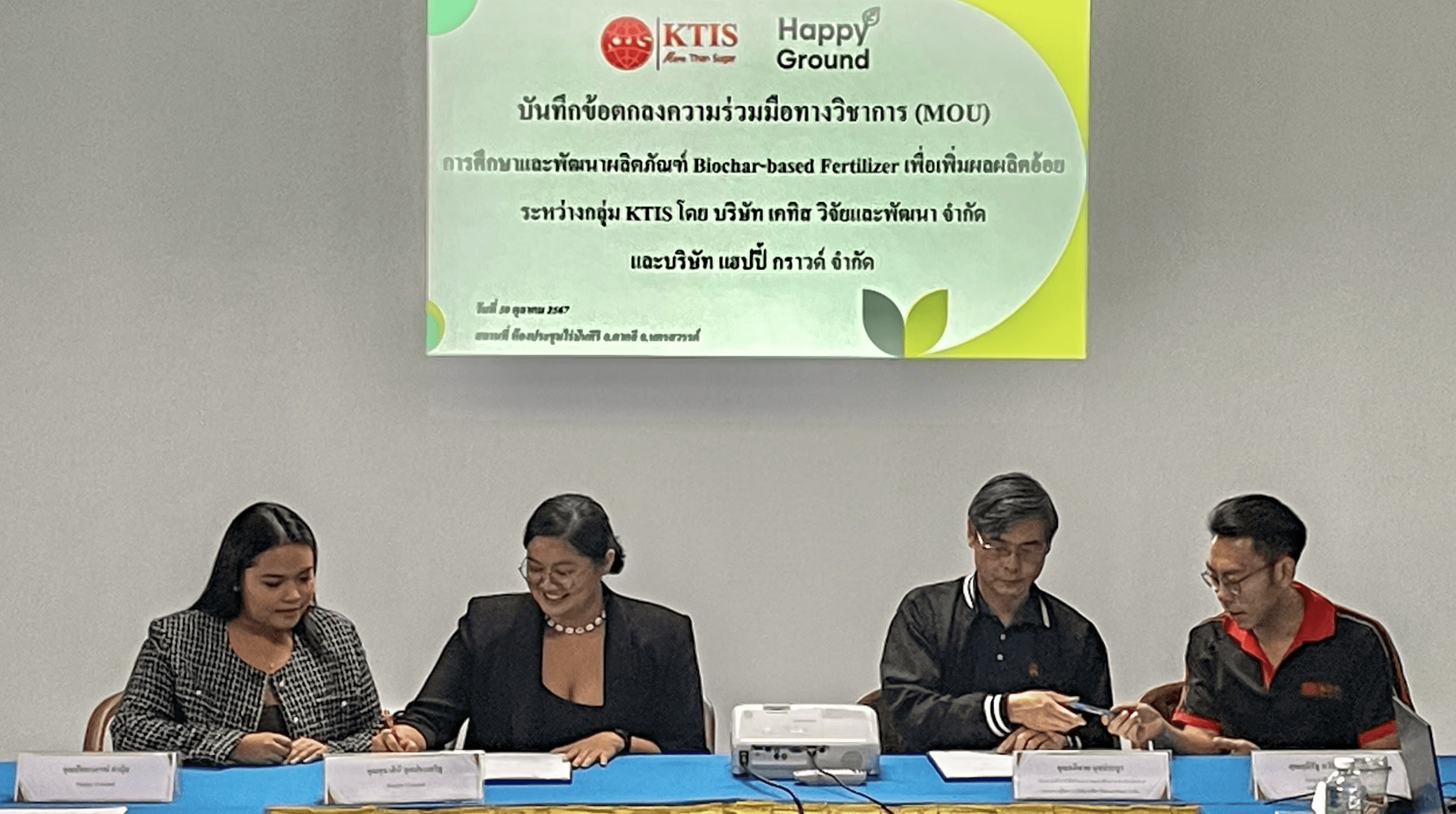
Since 2024, Happy Ground and KTIS have been working together on research around biochar, soil health and agricultural outcomes. The early work was deliberately focused on understanding what happens when an intervention reaches the farm: how it affects soil, yields and farmers, and whether it can create meaningful agricultural value in practice.
That research became the foundation for a much bigger conversation.
What climate transition initiatives could we build together if we knew they actually worked for the farmers and the supply chain?
Start with the farmer, not the carbon credit
It's easy to start a climate project by asking how many tonnes of CO₂ can be removed.
We started somewhere else.
Sugarcane farms in Thailand have historically relied heavily on chemical fertilizers, while many soils have become acidic and low in organic matter. KTIS itself identified the need to bring more organic carbon back into the soil as an important issue for long-term supply-chain security.
So our early research focused on a more fundamental question:
Can we introduce an intervention that actually improves the agricultural system?
That meant looking at things that matter directly to farmers: soil condition, crop performance, yield and how an intervention fits into real farming practices.
This matters because a climate intervention that looks good on a carbon spreadsheet but doesn't create value for farmers is unlikely to scale.
Our research was therefore not simply about proving a carbon methodology.
It was about finding something worth scaling in the first place.
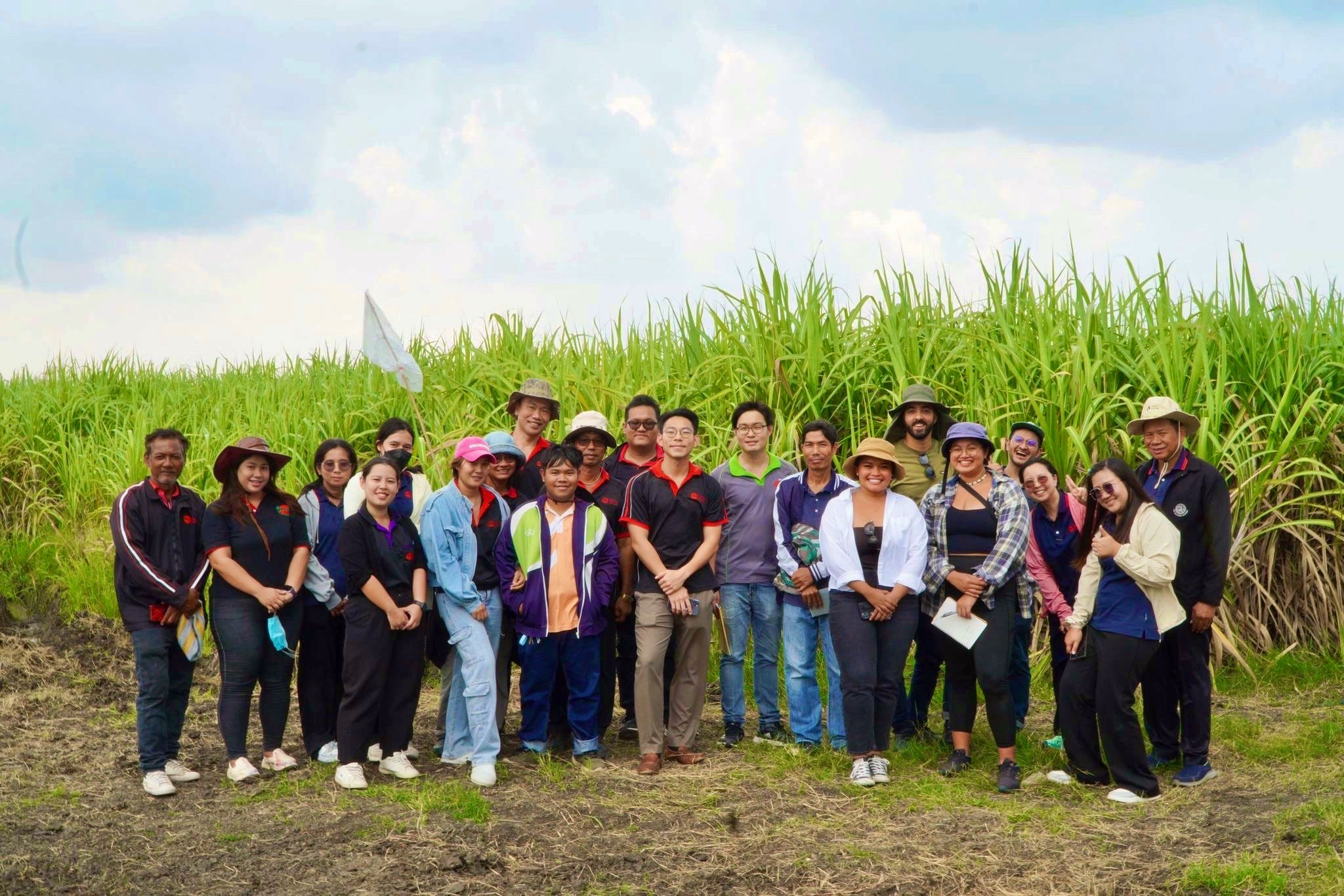
From research to a supply-chain opportunity
As we worked through the agricultural system, we began to see opportunities in materials that were already flowing through it.
Agricultural residues and by-products from the sugar mill and paper mill are already being processed into biofertilizer, creating a pathway for materials that might otherwise be treated as waste to return to agricultural systems.
That raised a bigger question:
Could these existing agricultural inputs contribute to building soil organic carbon?
This is one of the reasons we're now exploring VM0042, Verra's Improved Agricultural Land Management methodology, together with KTIS.
VM0042 provides a framework for quantifying greenhouse-gas emission reductions and removals associated with improved agricultural land management. One important pathway is soil organic carbon: when improved agricultural practices increase the amount of carbon stored in soil relative to the baseline, that additional stored carbon can represent a carbon removal when appropriately quantified and verified.
But again, the carbon credit isn't the starting point.
The starting point is:
Can we improve the soil?
Can we create value for farmers?
Can we measure that improvement?
Can we make the approach work across thousands of farms?
If the answer is yes, then carbon finance can become one mechanism to help scale it.
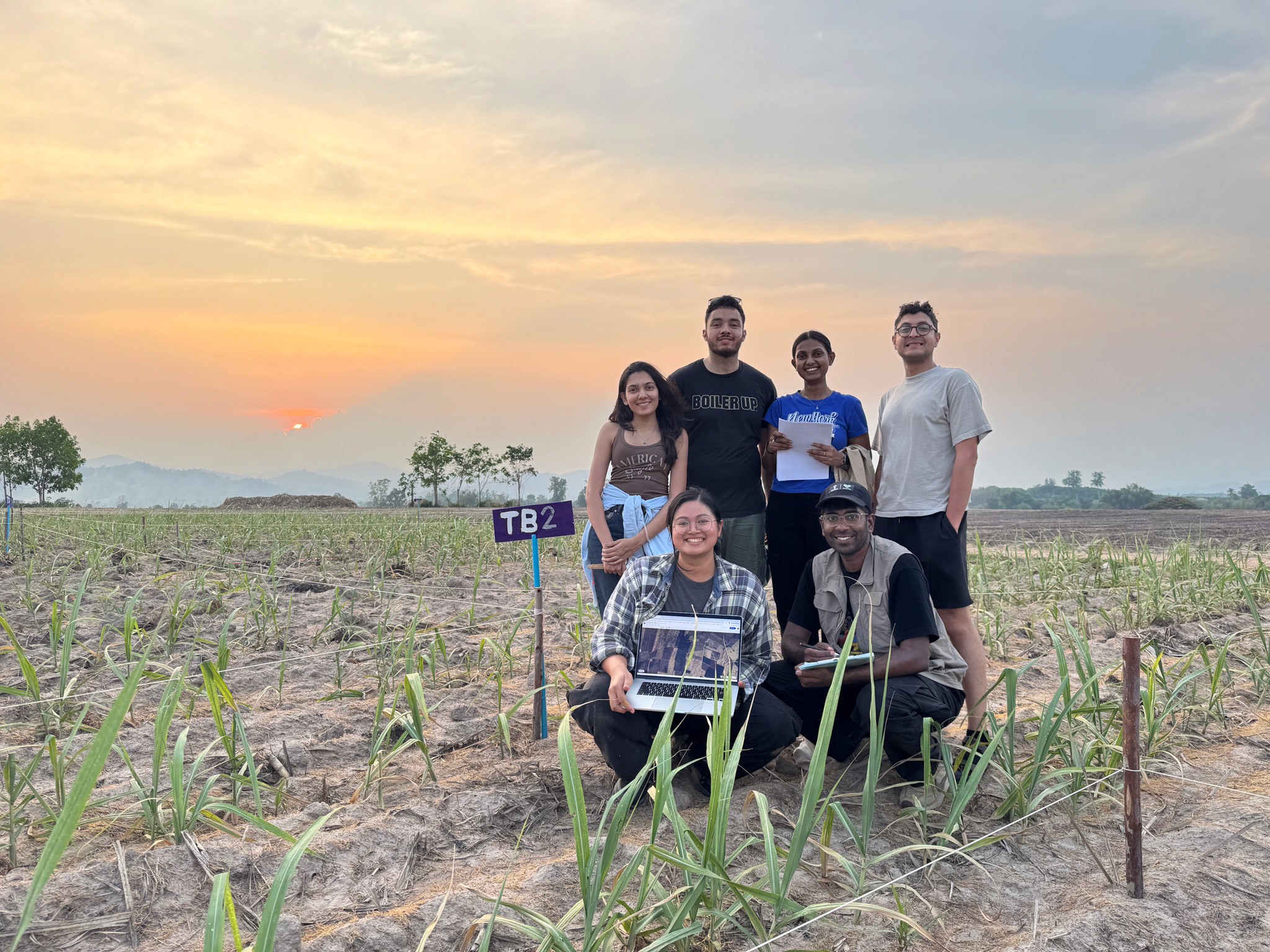
We're also exploring biochar
The research has also led us to another pathway within the sugarcane system: turning sugarcane leaves into biochar.
Biochar creates a different type of climate opportunity.
When biomass is converted through pyrolysis, some of its carbon is transformed into a more stable form. When that biochar is appropriately applied and durably stored, it can represent carbon dioxide removal.
That removal can potentially be quantified and converted into carbon credits through an appropriate carbon removal methodology and verification process.
This is fundamentally different from soil organic carbon.
With improved agricultural management, we are interested in increasing carbon stored in the soil.
With biochar, we are interested in converting biomass carbon into a more durable form and storing it in agricultural systems.
Both pathways can potentially create climate value.
But the underlying question remains the same:
Does the intervention create real value for the agricultural system?
This is why our work with KTIS isn't about deciding upfront that there is one perfect intervention.
We're exploring the different pathways available within the supply chain and trying to understand which ones make the most sense agronomically, operationally, economically and climatically.
The supply chain itself becomes the infrastructure
This is where KTIS becomes particularly interesting.
The collaboration is not happening on a handful of isolated demonstration plots.
We're working within an agricultural ecosystem involving 10,000 farmers and approximately 128,000 hectares.
That gives us something an R&D facility alone cannot provide: the opportunity to understand what it takes to move from “this works in a field experiment” to “this could work across a supply chain.”
KTIS already has relationships with farmers, agricultural infrastructure, processing facilities and material flows.
The opportunity is not to build another system beside all of that.
It's to connect climate transition to the system that already exists.
That means understanding where biomass is available, how farmers operate, how interventions can be delivered, how outcomes can be measured, and how the economics work across the entire system.
The real challenge is coordination
At this scale, agricultural transition isn't simply an intervention problem.
It has to work for multiple actors at the same time.
For farmers, it needs to fit into existing practices and create meaningful value.
For the factory, it needs to work within existing operations and logistics.
For the program, it needs to produce measurable agricultural and environmental outcomes.
For carbon markets, it needs credible methodologies, evidence and verification.
And for the enterprise, it needs to make economic sense as an investment.
That's a coordination problem.
This is where Happy Ground's role sits.
We connect the agricultural baseline, research, program design, intervention pathways, field implementation, data infrastructure, monitoring and carbon methodology into one program architecture.
The technology supports the system.
But the program is the product.
Making the transition measurable

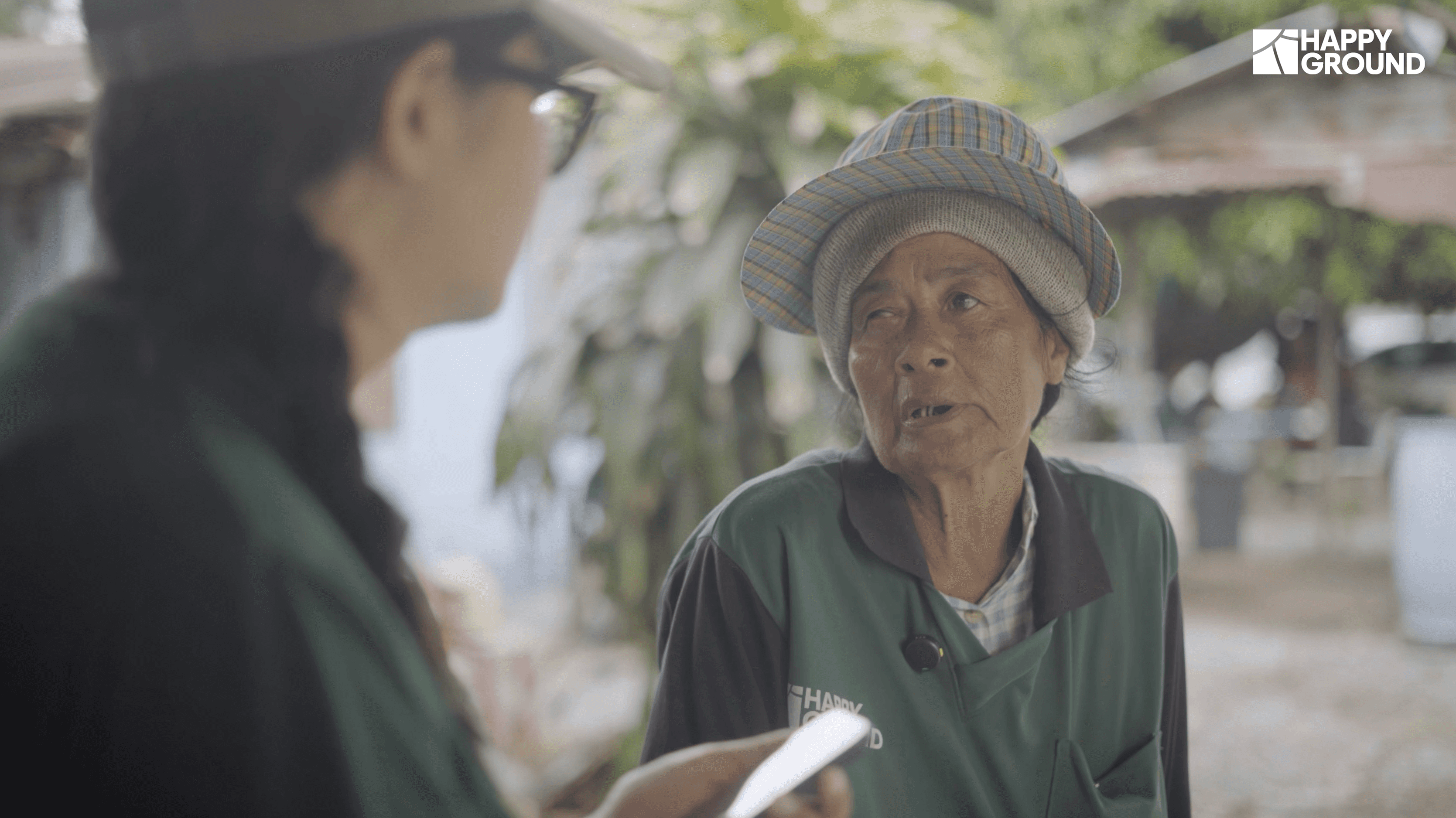
As programs grow, another challenge emerges: understanding what is actually happening across thousands of farms.
This is where Capture becomes part of the infrastructure.
Field teams can collect farmer conversations, observations, photos, GPS information and other evidence directly from the field, while AI structures the information as it is collected.
That gives us a much stronger foundation for connecting the farmer-level baseline to what happens later.
And the data doesn't exist simply for reporting.
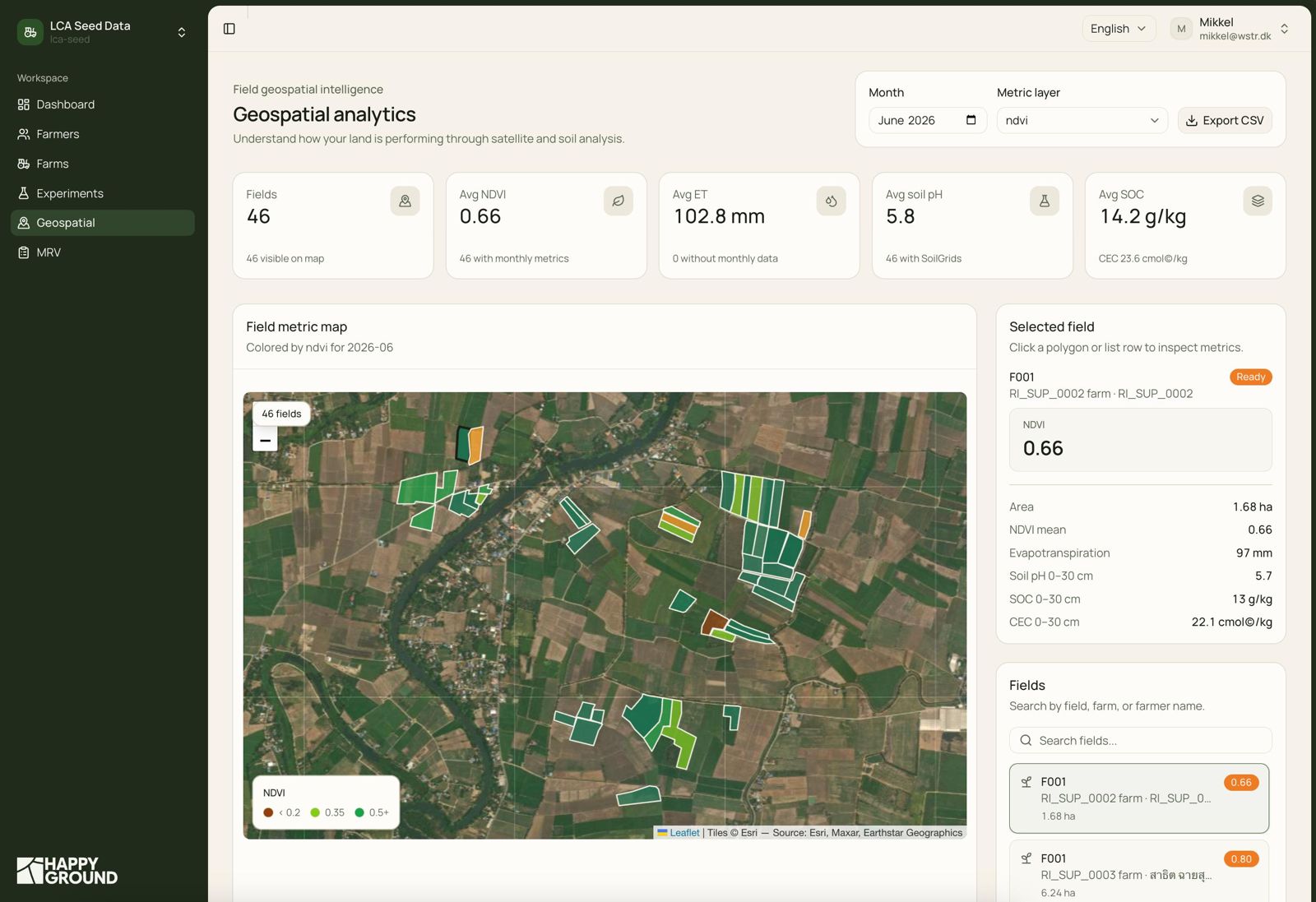
It can connect the different stages of the program:
Baseline → Intervention → Monitoring → Outcomes
Over time, those observations can help us understand which interventions work, under which conditions, and where additional investment might create the most value.
From agricultural research to carbon finance
This is the transition we're now exploring together.
The research tells us what may create value for farmers.
The agricultural data helps us understand where and how to deploy it.
Monitoring gives us evidence of what changes.
Methodologies such as VM0042 can provide a framework for quantifying relevant climate outcomes.
And where those outcomes meet the requirements of a carbon standard and verification process, carbon credits can become an additional source of economic value.
That creates a potential loop:
Better agricultural practices
→ Better soil and farm outcomes
→ Measurable climate impact
→ Potential carbon value
→ More investment into agricultural transition
The important thing is the direction of the loop.
We don't want farmers to change practices simply because there is a carbon credit attached to them.
We want practices that are worth adopting because they create real value — and then use carbon finance where possible to help make those practices more scalable.
What we learn becomes the next opportunity
This is where the longer-term vision comes in.
Every field experiment teaches us something.
Every farmer interaction adds another observation.
Every intervention creates another dataset.
Every monitoring cycle gives us more evidence.
And eventually, those observations can become intelligence.
That's the foundation for the Happy Ground data flywheel:
More deployments → more proprietary field data → better intelligence → better investment decisions → more deployments.
This is where Forecast becomes important.
The ambition isn't simply to tell an enterprise what happened.
It's to eventually help answer:
Where should we invest next?
Which intervention is most likely to work?
Which farms should be prioritized?
What outcomes could we expect?
What would implementation require?
The more we learn from real agricultural systems, the better those decisions can become.
Building something that can travel
KTIS is a sugarcane supply chain, but the underlying challenge is much bigger.
Rice, corn, cacao, coffee, rubber and oil palm all have different agricultural systems, biomass streams and economics.
The intervention may change.
The methodology may change.
The implementation model may change.
But the underlying approach can remain:
Research → Understand → Design → Deploy → Measure → Learn → Replicate.
That's what we're trying to build.
Not a single carbon project.
Not another disconnected sustainability pilot.
A repeatable infrastructure for turning agricultural transition into measurable, investable action.
Beyond one project
Our work with KTIS began with research because we believed that the first responsibility of a climate transition program is to understand whether it actually works for the people and agricultural systems it is supposed to serve.
That research has opened the door to a much bigger opportunity: connecting farmer outcomes, soil health, biomass, climate science, carbon finance and enterprise investment within one system.
The goal isn't to build one perfect intervention.
It's to understand what works, build the infrastructure around it, and make the next deployment easier.
Because the real opportunity isn't simply to create carbon credits from agriculture. It's to make better agriculture measurable, financeable and scalable.
That's what we're building with KTIS.
And we're looking for the next enterprises, supply chains and implementation partners to build with us.
Explore more.